Canada doesn’t harden
homes against wildfire.
Australia does. California does. Canada doesn’t. Our communities keep burning because the construction guidance doesn’t exist. We built it. It’s free. Based on the best research from around the world.
Three things you need to know
Your fire department is built for one structure fire at a time. When 50 homes are threatened simultaneously, they triage. Most homes receive no direct defence. This isn’t a failure — it’s how the system works. Your home’s survival depends on how it’s built, not on who arrives.
A code-compliant 1-hour fire-rated wall is designed to give you time to escape — then it burns. That’s the code working as designed. Nothing in the Canadian building code prevents a home from being destroyed by exterior wildfire exposure. The code was never meant to do that.
Australia’s AS 3959 has been mandatory since 2009. California’s Chapter 7A since 2008. Both require wildfire-resistant construction in fire-prone areas. Canada has nothing equivalent. The NRC published a research guide in 2021. Nobody turned it into buildable guidance — until now.
It’s not what you think
Most homes don’t burn because a wall of flame hits them. They burn because embers — tiny burning fragments carried 1–10 km ahead of the fire front — land in vents, gutters, gaps, and debris. Embers are the #1 ignition source. If your home can resist ember intrusion, it survives most wildfire events.
For homes closer to vegetation or neighbouring structures, radiant heat and direct flame contact add additional threats — but these are directional. Only the face exposed to the heat source needs upgrading. This per-face approach is central to what we built.
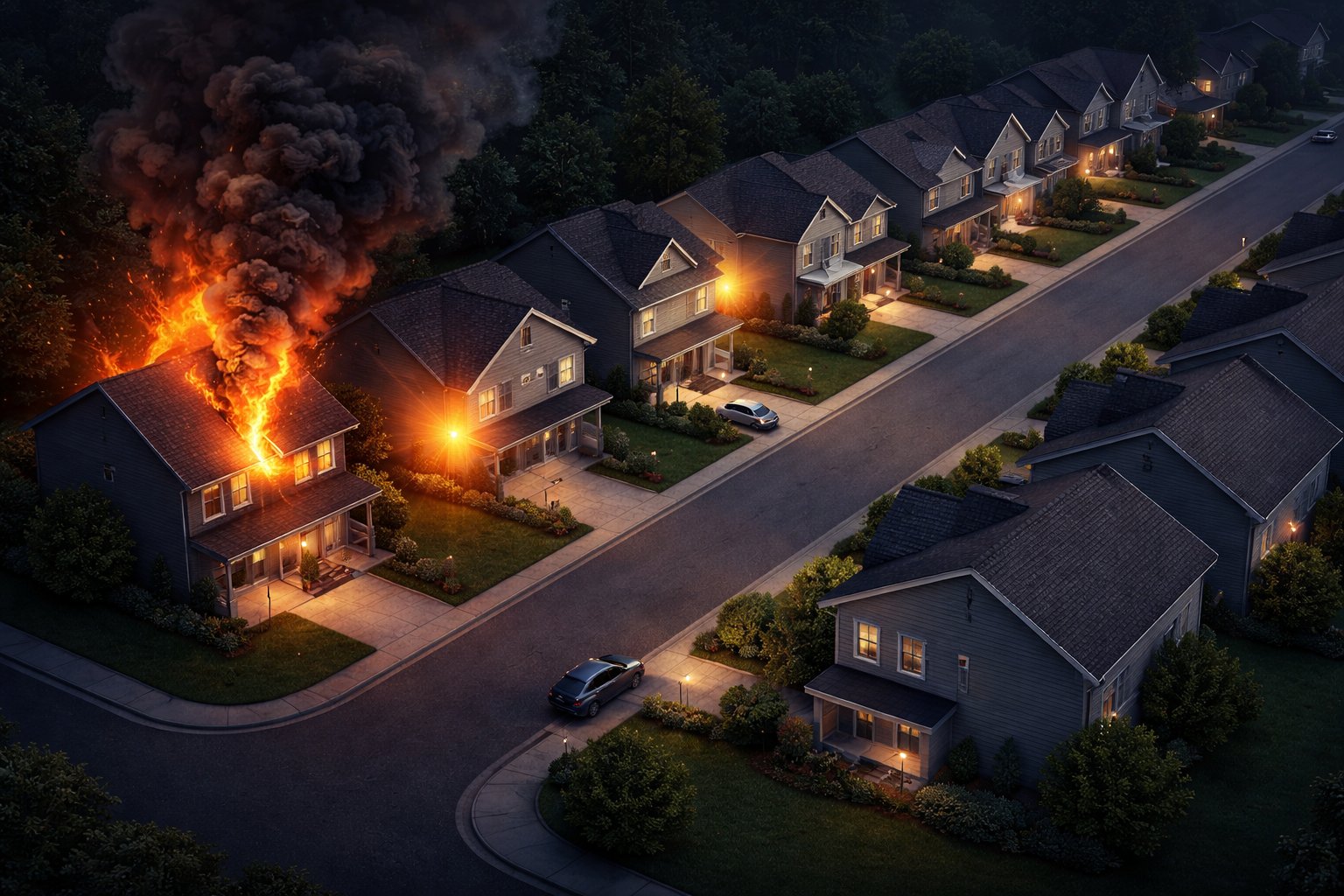
And it’s not just the forest. In a typical Canadian subdivision, homes are 2.4–6 metres apart. A fully involved neighbouring structure produces 20–80 kW/m² of radiant heat — enough to ignite combustible materials next door. Halifax 2023, Kelowna 2023, Fort McMurray 2016 — these weren’t cabins in the woods. They were subdivisions.
“We live in wildfire country. In 2023, fire burned three kilometres from our town. We looked for construction guidance we could hand a contractor — something a homeowner could actually use. It didn’t exist. So we built it. Evenings and weekends. A small group of building science professionals who got tired of waiting for someone else to do it.”
— The FireHard team · Smithers, BC · Population 5,400
We built the missing piece.
Free construction guidance for every level of wildfire exposure. Four levels. Per face. Voluntary.
See How It Works →