The FireHard system — including the WER rating, technical documents, and design guides — is a voluntary framework based on current best practices from wildfire research in Canada, the United States, and Australia. It is not a building code, regulation, or mandatory standard.

Your home can
stand its ground.

FireHard Canada is a free, specification-grade (detailed enough to build from) wildfire hardening system for Canadian homes. Four levels. Six technical guides. One principle: every home that hardens makes every neighbouring home safer.

Is FireHard for you?

If you think wildfire is a rural problem, the data says otherwise.

You live near trees or grassland

Windborne embers travel 1 to 10 km ahead of a fire front. If your home is within 10 km of forest, grassland, or scrubland — even across a highway — embers can reach your roof. Most Canadian communities outside major urban centres qualify.

You live in a suburb or small city

Halifax (2023). Kelowna (2023). Fort McMurray (2016). Slave Lake (2011). These weren't cabins in the woods — they were subdivisions, schools, and strip malls. Urban homes with vinyl siding and open eaves burn just as fast as rural ones when embers arrive.

You have neighbours within 10 metres

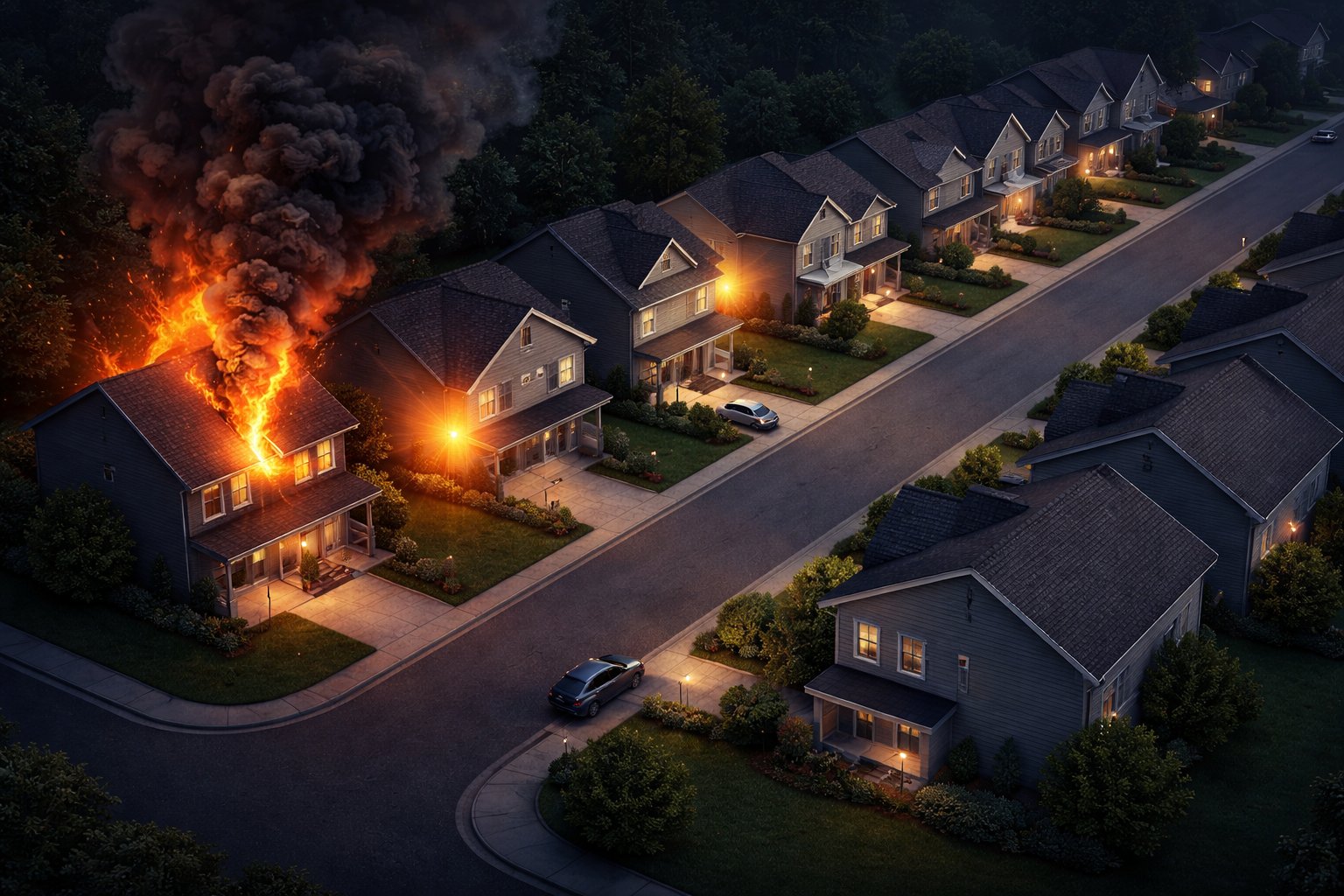
Structure-to-structure fire is the hidden multiplier. A burning home produces 20–80 kW/m² of radiant heat on adjacent walls — enough to ignite vinyl siding. In a typical Canadian subdivision, one ignition can cascade through a block. The CNEL system addresses this directly.

You think your area is "safe"

Canada's 2023 fire season burned 18.5 million hectares — 7× the 25-year average. Communities that had never experienced wildfire were evacuated. Climate projections show this accelerating. The Canadian Wildfire Information System (CWFIS maps) can show you fire weather risk for your region.

The short answer: If your home is within 10 km of forest, grassland, or scrubland — or within 10 metres of a neighbouring structure — FireHard is for you. The self-assessment takes 30 minutes and it's free. Start with WER-1 — most measures cost nothing.

Who doesn't need FireHard? Homes in dense urban cores (downtown Toronto, Montreal, Vancouver), coastal areas with no adjacent wildland fuel, and ecosystems not prone to wildfire (coastal rainforest, tundra, prairie farmland without adjacent grassland). If there's no fuel within 10 km and no close neighbours, your risk is structural fire — and the building code already covers that.

Canadian homes are burning. The solutions are known. The gap is access.

$8.5 billion in insured wildfire losses in 2024. Jasper. Lytton. Kelowna. The research is clear — NIST investigations, IBHS studies, Australian Standard AS 3959 — but the gap between what wildfire science knows and what a Canadian homeowner can actually do has been too wide.

We built FireHard to close that gap. Free guides. Open specifications. Because the only wildfire defence that works is one the whole community can access.

$8.5B
Canadian insured wildfire losses in 2024
73%
of Canadians worried about premium increases
10/10
California qualifying measures covered by WER
Free
All WER guides and assessment tools

Assess your exposure. Then harden against it.

FireHard works in two halves. The WER Rating System tells you how exposed your home is. The Design Guides tell you what to do about it.

🔍

Wildfire Exposure Rating (WER)

Four levels measuring your home's exposure to ember attack, radiant heat, and direct flame contact. Pass/fail criteria — it meets the specification or it doesn't. The FireHard system is a voluntary framework based on current best practices from wildfire research in Canada, the United States, and Australia.

Learn about WER →
🔧

FireHard Design Guides

Level-specific design guides with practical fixes you can implement now. No waiting. No wondering. Just clear steps to make your home safer before the next fire season.

Get your guides →

Four levels of exposure — each one builds on the last

WER levels are cumulative. WER-2 includes everything in WER-1, plus additional measures. WER-3 includes everything in WER-1 and WER-2. You never skip a level — you build up.

Wildfire Exposure Rating Levels

FireSmart covers the landscape. FireHard covers the building.

FireSmart Canada is the established national program for vegetation management and defensible space. FireHard fills the gap FireSmart doesn't cover — specification-grade construction details for the building envelope itself. Do both.

Learn how they work together →
Community Effect

Every home that hardens makes every neighbouring home safer. Community-level hardening is exponentially more effective than individual measures. That's why every FireHard guide is free.

Honest About Limits

No building is fireproof. Hardening reduces probability. We will never tell you your home is "safe." We will tell you it's safer.

We built this to hand it off

FireHard v1.0 is published and free to use today. Our goal is not to own this permanently — it's to build a specification-grade framework that can be adopted, refined, and maintained by the appropriate Canadian standards body, whether that's CSA, NRC, ULC, or a provincial authority. We're a small team in Smithers, BC. Canada's wildfire construction standard should be maintained by institutions with the resources and mandate to keep it current.

Until that happens, we're calling on engineers, architects, building officials, insurers, and homeowners to help refine and pressure-test this framework so it's ready for institutional adoption.

Know your risk and get protected today.

Don't wait for the next big fire. Find your WER level in 30 minutes. Free.

Help shape the future of wildfire-resistant construction

5 minutes. Anonymous. Your input guides our priorities and demonstrates community support.

Take the Survey →