The FireHard system — including the WER rating, technical documents, and design guides — is a voluntary framework based on current best practices from wildfire research in Canada, the United States, and Australia. It is not a building code, regulation, or mandatory standard.
Four levels of wildfire resistance. Measurable, verifiable, designed for Canadian construction. This is the assessment — how exposed is your home?
The Wildfire Exposure Rating system translates wildfire science into practical building specifications. Each level targets specific wildfire attack mechanisms: ember attack, radiant heat, and direct flame contact.
WER draws from NIST investigations, IBHS research, Australian Standard AS 3959, and Canadian building codes. Every specification is pass/fail — it meets the standard or it doesn't.
Once you know your WER level, the design guides tell you exactly what to do about it.
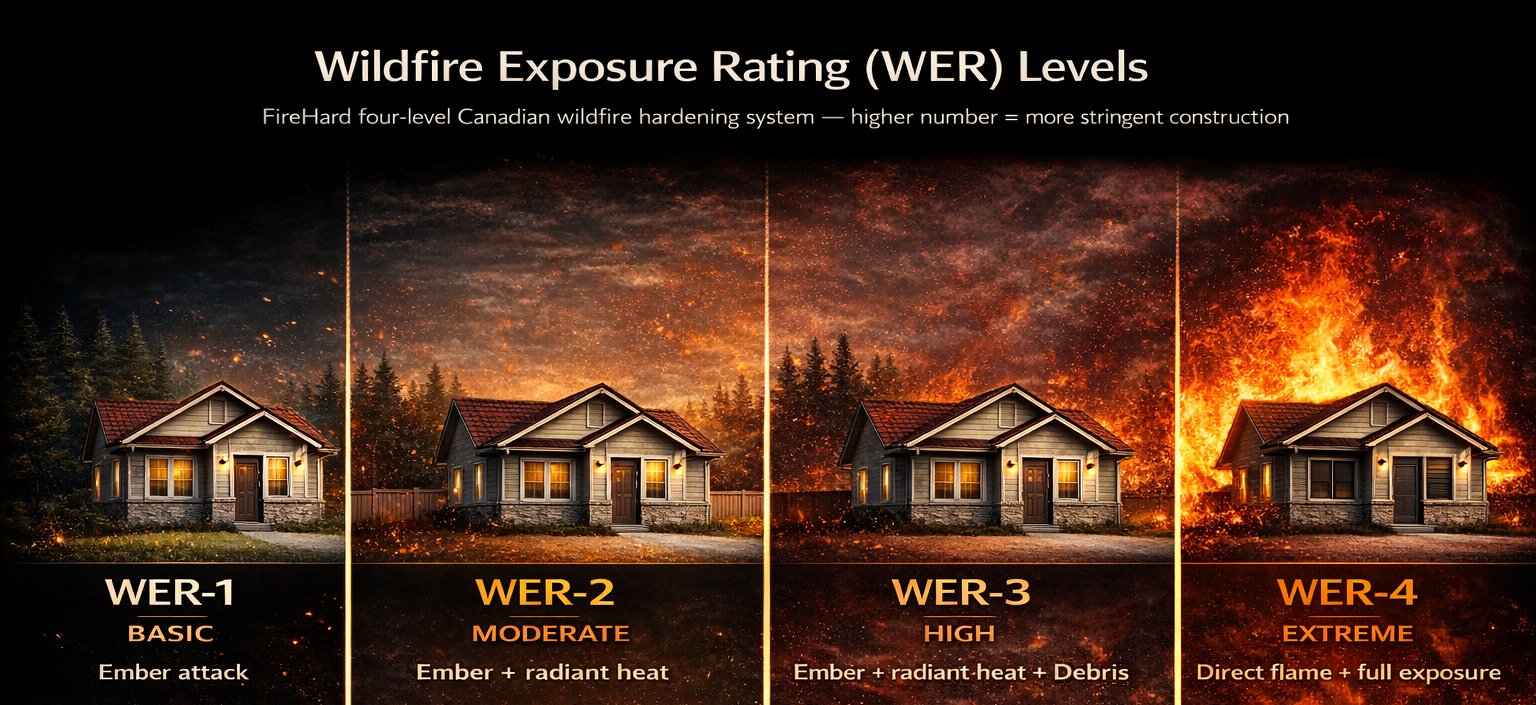
WER levels are cumulative. Each level includes all measures from the levels below it. WER-2 means you do everything in WER-1 plus WER-2 measures. WER-3 means WER-1 + WER-2 + WER-3. You never skip a level — you build up from the foundation of ember protection through radiant heat resistance to full flame contact defence.
Class A fire-rated roof. Gutter guards. 1.5m NC perimeter. Basic defensible space. CNEL system applies if neighbours within 10m.
Class A roofing, metal gutter guards, 1.5m NC perimeter zone, basic vent screening (3mm mesh), removal of combustible debris, and Zone 1 vegetation management. CNEL applies if neighbours within 10m: CNEL-1 (6–10m) — clear gap, NC ground cover, NC fencing, tempered glazing, enclosed soffits on facing elevation. CNEL-2 (3–6m) adds Type X sheathing and full NC cladding. CNEL-3 (<3m) requires fire-rated wall and wildfire shutters.
Enclosed NC soffits. Ember-resistant vents. Tempered glazing. NC or fire-rated fencing. CNEL measures on neighbour-facing elevations.
All WER-1 measures plus enclosed NC soffits, ember-resistant vents (ASTM E2886), tempered/laminated glazing, NC or fire-rated fencing within 6m of structures. CNEL on neighbour-facing elevations: CNEL-1 adds tempered glazing and NC soffits. CNEL-2 adds Type X sheathing, full NC cladding, mineral wool. CNEL-3 adds fire-rated assembly and shutters. Fire-rated timber alternatives accepted for fencing and outbuildings.
NC cladding to ground level. Wildfire shutters on all openings. NC or FRT decking. CNEL measures on neighbour-facing elevations.
All WER-2 measures plus NC cladding to ground (or engineered equivalent), wildfire shutters, NC/FRT decking, fire-rated timber options for outbuilding framing. CNEL on neighbour-facing elevations: CNEL-2 largely overlaps WER-3 specs. CNEL-3 adds sealed soffits (no vents), radiant heat barrier, and fire-rated shutters on all facing openings.
Complete NC exterior. BAL-40+ equivalent (Bushfire Attack Level, the Australian benchmark). No timber alternatives. P.Eng. assessment required. CNEL integrated into full envelope.
All WER-3 measures plus complete NC envelope (no timber alternatives), fire-rated wall assemblies, BAL-40+ equivalent (Bushfire Attack Level, the Australian benchmark), steel/bronze shutters all elevations, P.Eng. assessment with radiation modelling. CNEL fully integrated — WER-4 exceeds all three CNEL tiers. No additional CNEL measures required.
The WER system recognizes three pathways to meet each specification. This mirrors how building codes work — a prescriptive path for straightforward compliance, and alternative solution paths for flexibility.
Materials and assemblies explicitly named in the FireHard specification. If the design guide lists it, it meets the standard. Example: fibre cement panel, metal cladding, stucco, or masonry all satisfy "noncombustible cladding" without further testing.
Products tested to the referenced standard by a recognized testing laboratory. Example: an ember-resistant vent not listed in the guide but tested to ASTM E2886 by an accredited lab meets the WER-2 vent specification. The manufacturer's test report is the evidence.
A P.Eng. assessment demonstrating equivalent performance through analysis. Example: a heavy-timber fence post (140×140mm minimum) may satisfy the WER-2 fencing specification through charring rate analysis, even though it is not noncombustible. The engineer's sealed report is the evidence.
The WER system does not require everything to be noncombustible. Where a specification says "NC or fire-rated," fire-rated timber is an acceptable alternative when it meets minimum section dimensions. Large-section timber chars at a predictable rate (approximately 0.65mm/min for softwood per Eurocode 5) and can maintain structural integrity for defined periods.
For fencing, outbuilding framing, and deck substructure, timber sized to resist ignition for the design fire exposure period is an acceptable alternative to noncombustible materials at WER-1 through WER-3. Minimum section dimensions are specified in each design guide and in Construction Detail Guide 5 (Fencing) and Guide 6 (Walls & Cladding). At WER-4, all exterior materials must be noncombustible — no timber alternatives.
Most Canadian subdivision homes are built 1.5–10 metres apart. At these distances, a fully involved neighbouring structure produces enough radiant heat to ignite combustible materials on your home — regardless of your wildland exposure level. The CNEL system addresses structure-to-structure fire spread as a separate hazard from wildland exposure.
The CNEL system uses separation distance and your neighbour’s condition to determine the hardening level for each building face: CNEL-1 (moderate, 6–10m), CNEL-2 (high, 3–6m with unrated neighbour — the most common Canadian suburban scenario), and CNEL-3 (severe, under 3m or high-risk neighbour). Each level specifies exactly what to do to the facing wall, from clearing the gap at CNEL-1 through fire-rated wall assemblies at CNEL-3.
CNEL and WER are complementary — a home may have both a wildland WER level and one or more CNEL levels on different faces. Apply whichever is more stringent. Download the full CNEL Guide →
Standard construction details and specifications are currently under development. The design guides provide material specifications and general assembly requirements. Detailed construction drawings, product-specific installation guides, and the Component & Assembly Reference database are in active development. Take the survey to help us prioritize.
Help shape the future of wildfire-resistant construction
5 minutes. Anonymous. Your input guides our priorities and demonstrates community support.